Leahlee Duo: A Thoughtful Script & Serif Pair for Editorial Calm
It was a quiet Tuesday morning—coffee still warm, inbox mostly cleared—when I opened the cover layout for a new digital magazine feature on slow living. The headline needed warmth without whimsy, distinction without distraction. I’d tried three serif fonts and two script options separately, but nothing settled the page like a true pairing. That’s when I loaded Leahlee Duo. Within minutes, the title felt resolved—not just styled, but spoken. That’s the quiet strength of this Script Amp font set: it doesn’t shout. It listens.
A Typeface Designed for Dialogue
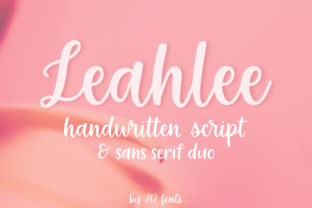
Leahlee Duo isn’t two fonts loosely bundled—it’s a considered duo. One is a graceful, slightly modulated script: not overly ornate, not rigidly formal, but alive with subtle variation in stroke weight and rhythm. The other is a refined serif—elegant, low-contrast, with gentle bracketing and open apertures. Together, they share an underlying warmth and human cadence. There’s no visual tension between them; instead, there’s resonance. You feel it in the way the script’s soft entry curves echo the serif’s terminal flourishes, or how their x-heights align to create visual cohesion across sizes.
This harmony makes Leahlee Duo especially effective in editorial contexts where tone matters as much as hierarchy—like a lifestyle blog redesign where authenticity and approachability are central, or a printable coaching workbook that balances inspiration with clarity. It’s not flashy typography. It’s felt typography.
Where Leahlee Duo Finds Its Rhythm
In practice, Leahlee Duo shines brightest where intention meets restraint:
- Cover text and chapter openers — The script carries presence without overwhelming; the serif grounds it with readability at medium sizes (18–24pt). Ideal for a recipe ebook title or a wedding guide’s section divider.
- Pull quotes and callouts — The script adds gentle emphasis, while the serif offers a calm counterpoint for attribution or context lines. Works beautifully in long-form newsletter features or digital magazine sidebars.
- Newsletter headers and social media graphics — Scales well on screen when used sparingly. The script holds its shape even at 32px on mobile, especially with generous letter-spacing.
- Printable planners and worksheets — The serif’s generous counters and open forms support legibility in PDF exports, while the script lends a personal, hand-crafted note to headers or motivational prompts.
What it’s not designed for—and this matters—is dense body copy, tight captions, or formal reports. The script isn’t meant for paragraphs. Even the serif, while highly readable, leans more toward display than extended reading. Think of it as your editorial voice’s punctuation, not its syntax.
Readability Across Formats
I tested Leahlee Duo across environments: web previews, exported PDFs, printed proofs, and mobile newsletters. On screen, both fonts render cleanly in modern browsers—no hinting issues, no blurriness—even at smaller display sizes (down to 16pt for the serif in subheads). In PDFs, the OpenType features hold up well, especially ligatures and stylistic alternates if enabled during export. For print, the serif’s ink-friendly contrast and generous spacing make it reliable for crisp letterpress or offset runs.
That said, always preview at actual usage size. The script’s delicate joins can soften at very small scales (under 14pt), so reserve it for headlines, quotes, and accents—not footnotes or data labels. And if your audience includes readers relying on screen readers or high-contrast modes, pair Leahlee Duo thoughtfully: use semantic HTML headings and avoid embedding script text as images.
Pairing With Purpose
Leahlee Duo invites thoughtful pairing—not because it needs fixing, but because it thrives in conversation. For body copy, I’ve paired the serif with a neutral, highly legible sans serif (think a clean, humanist typeface like Poppins or Lato) for navigation, captions, and running text. The contrast feels intentional, not jarring. For a more literary mood, a classic, higher-contrast serif like Adobe Garamond works surprisingly well—just keep line height generous to preserve breathing room.
The script also pairs elegantly with minimalist sans serifs in logo design or social banners, where its character adds warmth without sacrificing polish. Just avoid competing scripts or overly decorative display fonts—they’ll muddy the quiet confidence Leahlee Duo brings.
Before You License
Leahlee Duo is a premium font, and like any commercial font, it’s worth checking what’s included before integrating it into client work, templates, or paid digital products. Look for: multiple weights (especially a bold for the serif), true italics, extended Latin character support, and OpenType features like discretionary ligatures and contextual alternates. Confirm licensing covers your use case—ebook embedding, web font hosting, resale in Canva templates, or white-label course PDFs all have different requirements. Most reputable vendors provide clear usage terms, and many include WOFF2 files for web use and OTF/TTF for desktop applications.
There’s a quiet confidence in knowing your typeface choice supports both meaning and mood—not just looks good, but helps your reader settle in. Leahlee Duo doesn’t solve every typographic challenge. But when you need warmth with structure, charm with clarity, or a handwritten whisper beside a steady serif voice—it offers something rare: a partnership that feels like collaboration, not compromise.