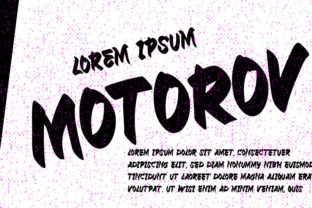
Motorov: A Timeless Script Font for Editorial Warmth
It was a quiet Tuesday afternoon—coffee lukewarm, laptop open to a half-finished newsletter header—and I found myself scrolling through script fonts again. Not for a client, not for a trend report, but for my own seasonal lifestyle blog redesign. The goal wasn’t flash or novelty. It was warmth. Clarity with character. Something that felt hand-touched but never fragile. That’s when Motorov landed softly in the preview pane—and stayed.
A Script That Breathes With Your Content
Motorov is a premium script font from the Script Amp category, designed with editorial rhythm in mind. Its strokes carry gentle contrast—not sharp enough to feel dramatic, not thin enough to vanish on screen. There’s a subtle bounce in its baseline, a relaxed cadence in its letterforms, and just enough variation in stroke width to suggest movement without sacrificing legibility. It doesn’t shout. It leans in.
I tested it first as a newsletter header over a soft watercolor background. At 36pt on desktop and 28pt on mobile, Motorov held its shape beautifully—no blurring, no awkward spacing collapses. The lowercase g and y have graceful descenders that anchor the line without dragging attention downward. Uppercase letters are confident but unhurried, with open counters and generous x-heights that support readability even at smaller display sizes.
Where Motorov Finds Its Editorial Home
Motorov isn’t built for body copy—and it shouldn’t be. Its expressive nature shines where intention matters most: titles, chapter openers, pull quotes, cover text, and branded headers. In a digital magazine layout, I used it for section titles above serif body text (a warm Garamond variant), and the contrast created instant hierarchy—without visual tension. In a printable coaching workbook, Motorov introduced personality to exercise headers and reflection prompts, giving structure emotional resonance.
For a recipe ebook, I paired Motorov with a clean, slightly rounded sans serif for ingredient lists and instructions. The script handled “Summer Berry Tart” on the cover and “A Note From Me” at the start of each chapter—never competing with the content, always supporting its tone. In a wedding guide PDF, Motorov appeared only on the cover, chapter dividers, and handwritten-style callouts (“Tip,” “Remember,” “You’ve Got This”). It added intimacy without undermining the document’s practicality.
Readability Across Formats—Thoughtfully Considered
Motorov performs consistently across environments: web, PDF, print, and even exported social graphics. On retina screens, its curves render crisply; in PDF exports, embedded outlines preserve fidelity regardless of viewer settings. For printables like planners or worksheets, it scales well down to 24pt for section labels—but I’d avoid anything below 18pt unless used decoratively (e.g., a single word in a corner graphic). On mobile, spacing remains generous, and kerning pairs hold up even when auto-scaling kicks in.
That said, Motorov isn’t suited for captions, footnotes, navigation menus, or dense paragraph text. Its charm lies in selectivity—not saturation. Using it for more than one or two lines per layout preserves its impact and avoids visual fatigue. Think of it like a well-placed accent color: powerful because it’s intentional, not because it’s everywhere.
Pairing With Purpose—Not Just Contrast
Script fonts live in relationship. Motorov pairs effortlessly with both classic serifs and contemporary sans serifs—but the key is mood alignment. With a warm, low-contrast serif like Adobe Caslon or EB Garamond, Motorov deepens the sense of craft and continuity. With a friendly, humanist sans like Inter or Lato, it adds approachability to modern layouts—ideal for newsletters or course PDFs targeting independent learners.
I avoided stark geometric sans serifs (like Helvetica Neue) in early tests—they created tonal dissonance, as if two different eras were speaking at once. Motorov prefers companions that listen. Also worth noting: check whether your Motorov license includes OpenType features like stylistic alternates or discretionary ligatures. In longer titles, swapping in a more flowing “&” or adjusting the “Th” pair can elevate polish without extra design labor.
Practical Notes Before You Implement
Motorov comes in a single weight—designed intentionally as a display font, not a family. It includes Latin-based multilingual support (covering Western and Central European languages), which matters for creators publishing beyond English-only audiences. File formats typically include OTF and WOFF2, making it viable for web projects with proper licensing.
Before using Motorov in client work, templates, or paid digital downloads, verify commercial licensing terms—especially if embedding in editable Canva templates or reselling as part of a design asset bundle. Some licenses restrict redistribution or require extended use fees for high-volume digital products. When in doubt, reach out to the foundry directly; clarity here prevents downstream friction.
What stays with me isn’t how Motorov looks—but how it behaves. It doesn’t impose. It responds. It gives space to words while holding them gently. In an era of relentless visual noise, that kind of restraint feels like a quiet act of care—for readers, for content, and for the quiet moments between them.