Bettie: A Handwritten Font That Breathes Life Into Editorial Moments
It was late afternoon, rain soft against the window, and I was finalizing the cover layout for a new digital magazine feature on slow living — twelve pages of essays, illustrated reflections, and quiet interviews. The headline needed to feel like a whispered invitation, not a shout. I cycled through half a dozen script fonts before landing on Bettie. Not because it was the flashiest, but because it settled into the space with a kind of gentle certainty — like ink drying just right on textured paper.
A Typeface That Moves With Intention
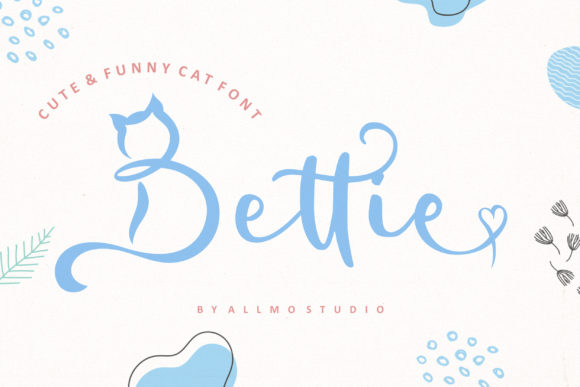
Bettie is a flowing handwritten font, but it doesn’t mimic haste or casual scrawl. Its rhythm is deliberate: smooth lines, subtle variation in baseline, and graceful swashes that lean into emphasis without overwhelming it. What makes it editorially useful isn’t just beauty — it’s consistency of voice. Each glyph feels hand-drawn, yet balanced enough to hold visual weight across sizes and contexts. As a display font from Script Amp, it’s designed for moments where tone matters as much as text.
The PUA encoding means every alternate, ligature, and decorative glyph is accessible without complex OpenType panels — a real relief when you’re layering text over photography in Canva or fine-tuning a newsletter header in Figma. You don’t need a typographic degree to unlock its personality; just select the character you want, and Bettie responds with quiet confidence.
Where Bettie Finds Its Rhythm in Real Layouts
I’ve used Bettie across several recent projects — a seasonal recipe ebook, a coaching workbook for mindful journaling, and a set of printable planner pages for creative professionals. In each, it served a similar role: anchoring emotional resonance without sacrificing clarity.
In the recipe ebook, Bettie headlines each chapter — “Spring Greens,” “Evening Bakes,” “Stovetop Rituals” — while a warm serif handles body copy. The contrast works beautifully: Bettie invites, the serif informs. On printed planner pages, its swashes add delicate punctuation to section dividers and motivational quotes — never competing with functionality, always enhancing intention.
For digital use, it performs well at larger sizes on screen — especially in newsletter graphics and blog headers — though I avoid using it below 24pt for body-level text. It’s not built for dense paragraphs or small captions. That’s not a limitation; it’s a design strength. Bettie knows its role: the opening line, the pull quote that lingers, the title that makes someone pause mid-scroll.
Readability Across Formats — Thoughtfully Considered
When exporting to PDF (for workbooks or printables), Bettie renders cleanly — no hint of pixelation, even at high-res print settings. For web use, embedding via @font-face works smoothly, though I recommend pairing it with a system-safe fallback for headings in case of loading delays. On mobile, it shines in hero sections and cover graphics, where its expressive flow reads as intentional, not cluttered.
That said, I wouldn’t use Bettie for long-form article text, formal reports, or accessibility-critical interfaces. Its elegance comes from expressiveness — which means lower contrast between strokes and more organic spacing than a utility-focused sans serif. That’s exactly why it excels in editorial design: it supports mood first, then meaning — always in service of the story being told.
Pairing With Purpose
My go-to pairings are simple and intentional. For body copy in ebooks and digital magazines, a relaxed serif like Adobe Garamond or a contemporary choice like Tiempos Text offers warmth and legibility without competing. For captions, navigation, or sidebar notes, a clean, neutral sans serif — Inter, Lato, or even system fonts like San Francisco or Segoe UI — creates clear hierarchy.
What’s refreshing about Bettie is how easily it integrates into existing brand systems. It doesn’t demand full rebranding — it asks only for thoughtful placement. A lifestyle blog might use it exclusively for post titles and featured quotes, keeping navigation and meta-text in a trusted sans. A wedding guide could let Bettie carry ceremony wording and chapter openers, while relying on a classic serif for timelines and vendor lists.
Before You Install — Practical Notes for Creators
If you’re planning to use Bettie in client work, templates, or paid digital products, double-check the commercial license — especially for ebook distribution or editable Canva templates. Most Script Amp fonts include OTF and WOFF files, multilingual support (Latin-based languages, including accented characters common in English, French, Spanish, and Portuguese), and a full set of alternates and ligatures.
There’s no bold or italic weight — Bettie is a single-style display font, and that’s part of its charm. Its impact comes from shape and spacing, not weight variation. So if your layout depends on strong typographic contrast within the same family, plan accordingly: use size, color, or pairing instead.
Also worth noting: while Bettie includes many flourishes, not all appear by default in basic text editors. To access swashes or contextual alternates reliably, use design tools that support OpenType features — Illustrator, Affinity Designer, or modern versions of Figma and Canva. For static PDF exports, pre-rendering those glyphs ensures they appear exactly as intended.
Bettie doesn’t try to be everything. It’s not a workhorse font — it’s a moment-maker. And in editorial design, where attention is scarce and mood is everything, that quiet precision is rare. It’s the kind of typeface that reminds you why we choose letters in the first place: not just to communicate, but to connect.