Singleday: A Modern Script Font for Digital Branding
As a UI designer who builds landing pages, SaaS dashboards, and e-commerce experiences, I’m constantly balancing personality with performance—especially when choosing type. Singleday stands out not because it’s flashy, but because it’s thoughtful: a modern script font that breathes lightness into digital interfaces without sacrificing clarity or usability.
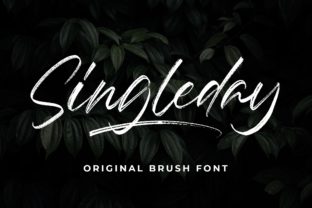
Singleday is a display font from Script Amp, designed with subtle bounce, open letterforms, and consistent stroke rhythm. It’s not a wild handwritten script—it avoids excessive flourishes or unpredictable connections. Instead, it delivers warmth through gentle curves, balanced spacing, and just enough character to feel human, not chaotic. That restraint makes it uniquely suited for screen-based contexts where legibility at scale matters more than ornamental excess.
In practice, Singleday shines in high-impact, short-form digital placements: hero section headlines, product name tags, CTA buttons, testimonial quotes, and branded banners for online stores. Its moderate x-height and generous counters ensure readability even at 24–36px on desktop—and when scaled to 20–28px on mobile, it holds up well in responsive headers and sticky navigation bars. For dark-mode interfaces or image overlays, pairing Singleday with a crisp white or soft off-white (and adding subtle text shadow or background contrast) maintains visibility without flattening its charm.
What sets Singleday apart for brand-focused web design is how it supports tone without dominating function. On a coaching website, it conveys approachability in the headline “Your First Step Starts Here”—not stiff, not saccharine, just grounded and inviting. In a boutique online store, it adds quiet confidence to product names like “Linen Wrap Dress” or “Ceramic Pour-Over Set.” And for creative portfolios or digital course sales pages, Singleday introduces editorial polish to section dividers (“What You’ll Learn”, “Meet Your Instructor”) while letting body copy—set in a clean sans serif—carry the weight of information.
It’s not ideal for long paragraphs or dense UI labels. Singleday is a script font, not a workhorse text face. Reserve it for moments where voice matters most: logo lockups (especially as secondary logotype or wordmark accents), social media graphics, email header banners, and branded PDF assets like pitch decks or course workbooks. When used this way, it reinforces consistency across touchpoints—not by repeating the same font everywhere, but by anchoring key brand moments with recognizable rhythm and warmth.
Font pairing is where Singleday truly earns its place in your toolkit. Pair it with a neutral, highly legible sans serif—like Inter, Manrope, or Work Sans—for all body text, form fields, navigation, and data tables. This contrast creates clear visual hierarchy: Singleday draws attention upward and outward; the sans serif grounds and guides. For editorial or luxury-facing sites, try it with a refined serif like Lora or Crimson Pro—but keep line height generous and font size intentional, since serifs + scripts can compete if not carefully balanced.
Singleday includes multiple weights (Light, Regular, Medium), OpenType features like stylistic alternates and ligatures, and full Latin multilingual support—including extended diacritics for French, Spanish, German, and Scandinavian languages. All webfont formats are included (WOFF2, WOFF), optimized for fast loading and cross-browser compatibility. If you’re using it in client projects, SaaS templates, or digital product kits, confirm your license covers commercial web use—including embedded fonts in hosted platforms like Webflow, Shopify, or Framer. Script Amp’s licensing is straightforward: one-time purchase with perpetual rights for websites, apps, and digital assets you own or build for others.
On mobile, test Singleday at real viewport sizes—not just in design tools. Its letter spacing tightens naturally on smaller screens, so avoid tracking adjustments below 16px. For buttons, use Singleday at 18–22px with ample padding and high-contrast backgrounds. Never stretch or skew the font to fit layout constraints; let its natural proportions guide spacing instead. And always test contrast against both light and dark UI modes—what reads beautifully on a white hero background may vanish on a charcoal footer unless adjusted thoughtfully.
In landing page design, Singleday helps convert by softening perceived friction. A bold, friendly headline like “Start Your Free Trial” feels less transactional and more personal—without undermining trust. That’s critical for subscription services, digital tools, or wellness offerings where users need emotional resonance before clicking. Likewise, in online shop banners—think “New Arrivals Just Dropped” or “Limited Edition Launch”—Singleday adds curated energy without shouting. It suggests intention, not urgency.
For blog headers or newsletter subject lines, Singleday works best when isolated: one phrase, centered or left-aligned with breathing room. Avoid stacking it with other decorative fonts or overloading it with icons. Its strength lies in simplicity—so give it space to speak. And when building a full brand kit, treat Singleday as a signature accent: use it consistently in the same contexts across your site, emails, and social visuals. That repetition builds recognition faster than any logo alone.
Ultimately, Singleday isn’t about trend-chasing. It’s about having a reliable, expressive tool that aligns with how people actually read and respond to digital interfaces today—quickly, contextually, emotionally. It supports brand identity not by being loud, but by being unmistakably *you* in the right places. Whether you're launching a new product, refining an existing site, or building reusable design systems, Singleday earns its place as a premium font that performs as thoughtfully as it looks.