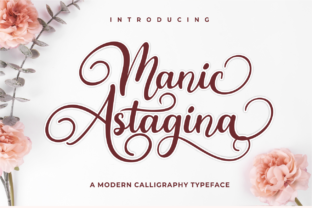
Manic Astagina: A Premium Script Font That Elevates Real Small Business Branding
Last Tuesday, I was helping a local candle maker finalize her new line of lavender-vanilla soy candles—hand-poured, eco-wrapped, and deeply personal. She’d spent weeks perfecting the scent, the vessel, even the wax melt texture. But when she pulled up the draft label in Canva, something felt off. The font looked “nice,” but not *hers*. It didn’t whisper warmth and craftsmanship—it whispered generic stock template. That’s when we swapped it out for Manic Astagina. Within minutes, the label transformed—not because the words changed, but because the typeface did.
A Script Font with Soul—and Serious Design Intelligence
Manic Astagina isn’t just another decorative script. It’s a Script Amp font built for impact: elegant without being fussy, fluid without sacrificing clarity, and deeply rooted in classic calligraphy—but with modern rhythm. You’ll notice how the baseline gently undulates (not rigidly flat), how strokes swell and taper like ink on paper, and how each glyph—especially the lowercase a, g, and y—carries subtle personality. It’s not overly ornate, so it never competes with your product or message. Instead, it invites attention with grace.
What makes Manic Astagina especially valuable for small businesses is its intentionality: it’s designed as a display font, meaning it shines brightest at larger sizes—logos, packaging headers, menu titles, social banners—but also holds up beautifully on smaller printed elements like thank-you card accents or boutique tags, provided you use it thoughtfully (more on that below).
Where It Actually Works in Your Day-to-Day Branding
I’ve tested Manic Astagina across six real business touchpoints—and here’s what stuck:
- Product labels & packaging: On a matte kraft candle jar label, Manic Astagina’s smooth curves softened the industrial look while keeping legibility intact—even at 14pt for scent names. Paired with a clean sans serif (like Montserrat or Inter) for ingredients and weight info, it created instant hierarchy and warmth.
- Café menus: Used for section headers (“Our Pastries,” “Seasonal Specials”), it added quiet sophistication without overwhelming the food photography. Customers commented that the menu “felt intentional”—a sign the typography was doing its job.
- Instagram story templates: As a headline over soft lifestyle photos, it read clearly on mobile—even at thumbnail size—because of its generous letter spacing and strong stroke contrast.
- Thank-you cards & stickers: Printed on textured cotton paper, the font’s organic flow made handwritten notes feel elevated, not impersonal. Bonus: the included stylistic alternates let us swap in a more delicate ‘&’ or swash ‘t’ for special editions.
- Online shop banners: On Shopify, used sparingly in hero banners (“Handmade with Care” or “Small Batch, Big Heart”), it anchored the visual tone without slowing load time—thanks to lightweight OTF/TTF file formats.
Readability + Real-World Practicality
Let’s be honest: not all beautiful fonts work on tiny soap labels or Instagram avatars. Manic Astagina handles small-scale use *if* you keep it to short, high-impact phrases—think “Est. 2021” stamped on a ceramic mug, or “Vegan • Cruelty-Free” on a skincare tube. Avoid using it for body copy, ingredient lists, or fine print. Its strength lies in emphasis, not exposition.
On screens? It performs well—especially when exported as web-optimized WOFF2 for websites or embedded cleanly in design tools like Figma or Adobe Express. Just remember: always preview on both desktop and mobile before finalizing. And if your brand serves international customers, double-check that Manic Astagina includes extended Latin characters (it does)—so names like “José” or “Müller” render correctly on packaging and digital ads.
Smart Pairings That Feel Effortless
Manic Astagina thrives in contrast. Its expressive nature means it pairs best with something grounded—never another busy script. Here’s what consistently works:
- A warm, neutral sans serif font (like Poppins or Lato) for supporting text—clean, friendly, highly readable.
- A refined serif font (such as Playfair Display or Cormorant Garamond) for editorial moments like blog headers or newsletter intros—adds timeless authority.
- A minimalist handwritten font (used *very sparingly*, like for a tagline flourish) can echo its organic feel—but only if it’s light in weight and low in contrast.
The golden rule? Let Manic Astagina lead, then step back. One dominant script font is enough. Clutter kills consistency—and consistency is what makes customers recognize your brand across a shelf, a feed, and a receipt.
Licensing, Files, and What to Check Before You Commit
As a commercial font from the Script Amp collection, Manic Astagina comes with full commercial licensing—meaning you’re covered to use it on physical products (candle jars, bakery boxes, fabric tags), digital assets (social posts, email headers), client projects, and even resale templates (as long as you’re not redistributing the font files themselves). Always verify the license covers your specific use case—especially if you plan to embed it in apps or SaaS platforms.
Inside the download, you’ll find OpenType (.OTF) and TrueType (.TTF) files, plus access to ligatures, stylistic alternates, and multilingual glyphs. No need for advanced design software to access them—most modern tools support OpenType features natively. Just open the Glyphs panel in Illustrator or the Character panel in Canva Pro, and explore the options. A few thoughtful swaps can make your branding feel custom-made—not off-the-shelf.
At the end of the day, typography isn’t decoration. It’s tone of voice in visual form. And Manic Astagina gives small businesses a way to say “we care about craft, detail, and how people feel when they see our name”—without saying a word.