The Magic Handwritten Font for Warm, Authentic Branding
It was a Tuesday morning—coffee in hand, client mood board open on my screen—and I needed a font that felt like a quiet “yes.” Not flashy. Not overly polished. Just genuine. That’s when I opened The Magic, the friendly handwritten font from Script Amp, and dropped it into the logo draft for a new neighborhood ceramic studio. Instantly, the composition softened. The lines breathed. It wasn’t just legible—it felt *known*.
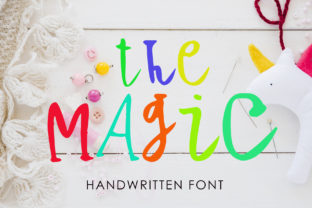
The Magic is exactly what its name suggests: effortless charm, with gentle pressure variation, subtle bounce, and a rhythm that mimics natural handwriting—not stiff calligraphy, not over-illustrated script, but something warm and human. The lowercase ‘a’ has a soft loop; the ‘g’ curls just enough to feel intentional; the ‘t’ crossbar lifts slightly, like a smile. It’s a premium font built for personality, not perfection.
I used it first as a display font—strictly for the studio’s logo lockup and shop sign. On a matte black enamel sign mounted beside a sunlit clay kiln? It held up beautifully. No pixelation, no awkward spacing. The letterforms have generous x-height and open counters, so even at 24 inches tall, every curve read clearly from the sidewalk. That’s crucial: a handwritten font can easily vanish at scale, but The Magic balances delicacy with presence.
For stationery, I tested it across business cards, thank-you notes, and product tags. Printed on uncoated cotton paper, the ink feathered just enough to enhance the handmade vibe—no digital sterility. Because The Magic includes stylistic alternates and standard ligatures (like ‘fi’, ‘fl’, ‘ct’), I could swap in a more playful ‘&’ or adjust the ‘y’ tail for better line rhythm in short phrases like “Hand-thrown • Small-batch • Local.” Those small refinements matter when you’re building recognition across touchpoints.
What surprised me most was how well it worked in digital spaces. I dropped The Magic into the hero section of their website mockup—paired with a clean, neutral sans serif (Inter, set at 18px) for body copy—and the contrast felt intuitive, not jarring. The script didn’t shout; it invited. On Instagram posts, it performed equally well: bold enough for a cropped square graphic (“New Glaze Drop →”), light enough for a delicate story highlight icon. As a headline font or accent font—not body text—it elevates without overwhelming.
That said, I wouldn’t use The Magic for long paragraphs, ingredient lists, or legal disclaimers. It’s not designed for extended reading. Its strength lies in short-form text: names, slogans, labels, greetings, titles. Think “Est. 2023”, “Small Batch • Big Heart”, or “Hand-poured Soy Wax” on a candle label. There, it adds warmth and distinction where generic sans serifs would fade into background noise.
Font pairing came naturally. With its organic flow, The Magic pairs beautifully with sturdy serifs (like Adobe Garamond or EB Garamond) for editorial pieces or packaging back panels—creating visual hierarchy without tension. Against a modern geometric sans (e.g., Poppins or Söhne), it adds soul without sacrificing clarity. I avoided pairing it with other script fonts—too much movement competes—but one alternate weight (if available) or a single monoline handwritten companion could work for layered texture in print collateral.
Before locking it into the full brand system, I ran three quick tests: First, I printed a set of mockups at actual size—business card, sticker, tote bag tag—to check spacing and legibility under real lighting. Second, I exported a few social banners and viewed them on my phone in natural light—no zooming required to read the tagline. Third, I checked licensing: yes, The Magic includes commercial font rights for unlimited projects, web embedding (WOFF2), and desktop use—critical for client deliverables like Shopify themes or Canva templates.
File-wise, it arrived as OTF and WOFF2, with full Latin character support—including accented characters for common European languages. No extended Cyrillic or Arabic, but for most small creative businesses in English-speaking markets, it covers the essentials cleanly. And while it doesn’t offer multiple weights (it’s a single-style script font), that simplicity is part of its appeal: focused, intentional, easy to manage in a lean brand kit.
In practice, The Magic shines brightest when authenticity matters more than uniformity. A skincare brand launching minimalist amber glass bottles? It adds tactile warmth to the label without competing with the product’s quiet elegance. A local bakery designing seasonal postcards? It makes “Fresh Croissants • Baked Daily” feel personal, not promotional. Even for a freelance illustrator building their own portfolio site, The Magic in the headline says, “I make things by hand”—before a single image loads.
One note: always test kerning manually. Handwritten fonts don’t auto-kern like system fonts, so I adjusted spacing between ‘A’ and ‘W’ in “Artisan Workshop” and tightened the gap after ‘T’ in “Tea + Toast”. Ten seconds in Illustrator saved hours of client revisions later. And if your project includes multilingual copy, double-check glyph coverage early—some accents or diacritics may need manual substitution.
Ultimately, The Magic isn’t about trend-chasing. It’s about choosing a typeface that aligns with voice before visuals—where the letterforms echo the values: care, craft, connection. In a world of algorithm-driven feeds and templated designs, a font like this reminds us that branding isn’t just seen—it’s *felt*. And sometimes, the most powerful design decisions are the quietest ones: a single word, written by hand, placed just right.